Soucy
Michael Erickson: Aftermarket Account Manager
How to choose best track machine for specific application and soil type, then make decision on optimum track width?
Dual Track Friction Drive Tractors are best suited for high-horsepower drawbar applications across long straight fields. They offer excellent traction and fuel efficiency in heavy tillage applications. They have a simpler undercarriage compared to four track machines and generally cost less to own and maintain. On the downside, they tend to create more berming when turning and are less maneuverable in challenging conditions than four track machines.
Four Track Articulated Positive Drive Tractors are best suited for large acre operations utilized for heavy tillage and planting operations. They are also well suited for wet conditions requiring maximum flotation and traction. They usually have a higher acquisition cost as well as more components that require regular maintenance. They are larger machines that are not as useful in smaller fields.
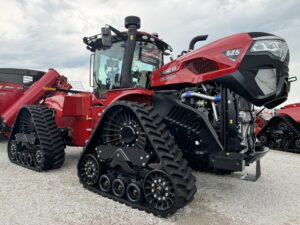
Four Track Articulated Positive Drive
Four Track Front Steer Positive Drive Tractors are best suited for row crop applications requiring high maneuverability by producers needing both flotation and precise steering. These tractors steer much like tractors on tires. They damage less crop and don’t disturb the soil as much during turns. They usually cannot match the pure drawbar performance of the other two machines.
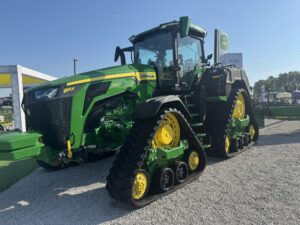
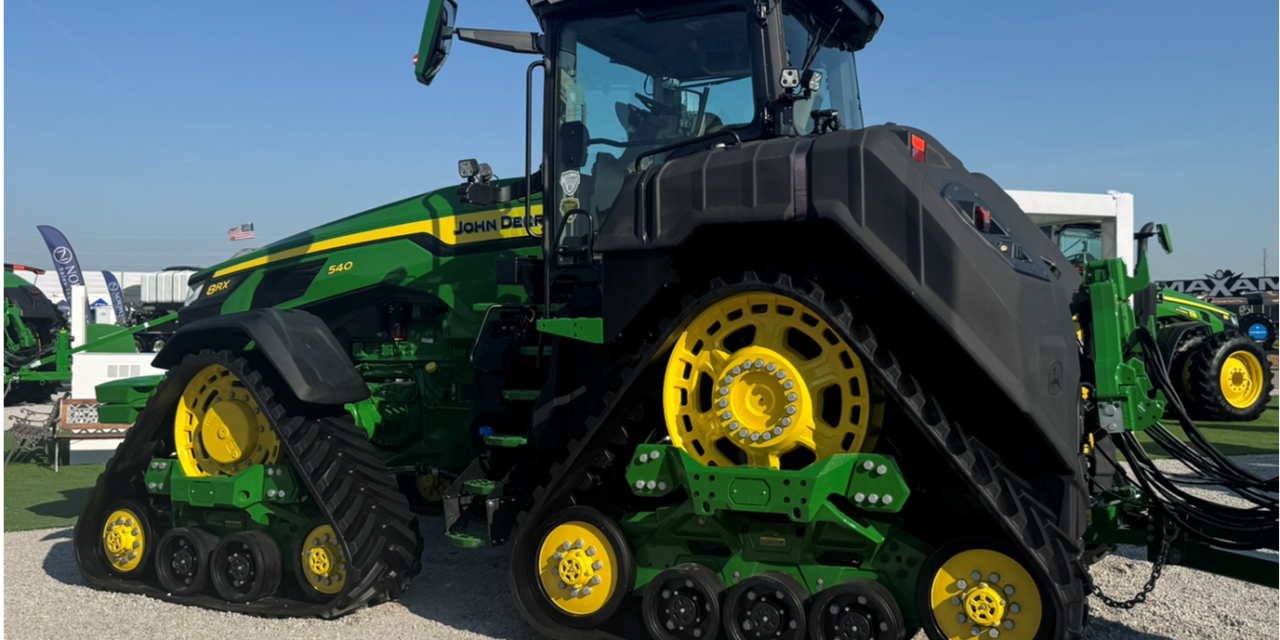
Four Track Front Steer Positive Drive
How does producer determine optimum track width?
There are many factors that go into choosing the track width for your operation. You need to balance traction, flotation, compaction management, transport requirements and the row spacings on your farm. A farmer should consider the soil type (light, medium or heavy clay), typical moisture conditions as well as horsepower and machine weight, the size and draft load of your implements and any transport or road width restrictions when choosing the track width.
Narrow tracks are usually chosen when operating in row crops where maintaining the row spacing is crucial and more ground pressure is needed for traction in firmer soils. The narrow tracks fit between the rows with less damage to the crops.
Wider tracks are chosen when machines work in soft, wet soils and pull heavy loads when you want to minimize rutting and maximize flotation. The larger footprint distributes the weight of the machine over a larger area reducing surface pressure. It also provides better flotation in soft conditions.
Can I change track width on machine if my operation changes?
Track width can be changed in many cases. Changing track width can be expensive because most of the time it requires changing parts of the undercarriage to accommodate the changed track width. Changing the track width may make sense when you are transitioning away from row crops to a more broadacre operation, have soils that are requiring greater flotation, or you have increased the size of your implements.
This chart can help to determine which option fits your operation.
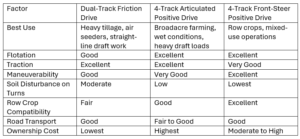
In summary:
Dual-track tractors are ideal for producers focused on maximum drawbar efficiency. Four-track articulated tractors provide the greatest flotation and performance in challenging conditions. Four-track front-steer tractors offer the best balance of flotation, maneuverability, and row-crop compatibility.
Trackman Tracks
Collin Koker: Technical Sales Representative
“If I Need Tracks, What Do I Need, and Why?”
Choosing the right track setup starts with the application. There is no single-track machine or track width that is best for every operation. Soil conditions, cropping practices, horsepower requirements, implement loads and transportation needs should all be considered alongside ROI and total cost of ownership.
Soil Type, Agronomy and Track Width
Four-track machines generally offer advantages in overall weight distribution and ground pressure, while also helping minimize soil disturbance and soil berm during turns. Dual-track machines can also provide excellent flotation and compaction performance, particularly when matched properly to the machine’s weight and application.
Track width and gauge should be determined by how and where the machine will operate. Operations using true row crops, beds, intercropping, relay cropping or tramlining may benefit from narrower tracks or specific gauge widths to better manage traffic between rows. Where these practices are less of a concern, a wider track and appropriate gauge can increase the machine’s footprint, reduce ground pressure and improve the transfer of horsepower to the ground.
The application may also change throughout the year. High-draft applications such as fall tillage can benefit from a wider track footprint to help maximize traction, reduce slip and improve efficiency.
During planting, spraying or in-crop applications, a narrower track or different gauge may be better suited for row spacing and controlled traffic.
Some machine and undercarriage designs allow different track widths to be used on the same machine. Depending on the design, changing widths may require changes to components such as midrollers for proper fitment. Producers should always follow OEM guidance when considering changes to track width or undercarriage components.
Choosing the Right Machine Configuration
4-Track Articulated Positive Drive: This configuration is well suited for high-horsepower, high-draft applications where large implements and maximum productivity are priorities. Positive drive helps manage slip under demanding loads, making these machines particularly effective in higher-horsepower applications. The four-track design also provides strong weight distribution and flotation.
The tradeoffs include a larger and heavier machine, transportation considerations, additional moving and wear components and potentially higher maintenance costs. In lower-horsepower or lighter-duty applications, producers should evaluate whether the additional size and complexity provide enough return for their operation.
Dual-Track Friction Drive: Dual-track machines can be a strong fit for mid- to higher-horsepower applications where versatility, efficiency and a smaller overall machine footprint are priorities. In steady applications, these machines can offer strong fuel efficiency due to the lower effort required to drive the track system.
As horsepower and draft loads increase, however, slip can become a larger factor and may affect the fuel efficiency advantage. Versatility is one of the major advantages of this configuration. Depending on the machine design, gauge width can often be adjusted more easily to accommodate different row spacing and applications. Transportation width and road handling can also be important advantages for operations that frequently move equipment between fields.
4-Track Front-Steer Positive Drive: This configuration offers a hybrid of four-track flotation and positive-drive performance in a more compact package than a traditional articulated four-track machine. It can be a strong option for row-crop operations needing higher horsepower, reduced ground pressure and maneuverability.
It provides many of the traction advantages of positive drive while offering the versatility of a front-steer machine. However, producers should consider higher upfront investment and operating costs when evaluating the overall ROI. For many operations, this configuration falls between a dual-track machine and an articulated four-track machine in terms of efficiency, size and capability.
The Bottom Line
The best track setup depends on the operation, not simply the highest horsepower or widest track available. Producers should consider their soil conditions, cropping practices, row spacing, implement loads, horsepower requirements, transportation needs and how the machine will be used throughout the year.
Ultimately, the right combination of machine configuration, track width and gauge is the one that delivers the best balance of traction, flotation, efficiency and versatility while providing the strongest return over the life of the machine.
At Trackman, we believe the conversation should start with the application. Understanding how and where a machine will work is the best way to determine the track setup that will deliver long-term performance.
Rubber Track Solutions
Jerry Von Gruenigen: V.P. Sales & Marketing
Choosing the right track setup for an agricultural machine isn’t just about picking a track. Producers also need to consider the machine platform, soil conditions, horsepower, implement weight, row spacing, and how the machine will be used.
Here’s how to think through the decision.
Which Ag Track Machine Is Right for Your Operation?
There are three common configurations to consider: dual-track friction drive, 4-track articulated positive drive, and 4-track front-steer positive drive.
Dual-Track Friction Drive
A 2-track friction-drive machine can be a good fit for general row-crop agriculture, long straight pulls, and dry to moderately moist soils.
Its biggest advantages are simplicity, durability, and lower cost of ownership. With fewer moving parts and less component wear, these systems can provide longer track life.
The tradeoff comes in wet conditions, where steering can become more challenging because of reduced internal traction.
Best fit: Producers who prioritize simplicity and durability and don’t regularly operate in wet or highly variable conditions.
4-Track Articulated Positive Drive
When maximum traction is the priority, a 4-track articulated positive-drive machine may be the better choice.
Positive sprocket engagement delivers more torque to the ground and provides better directional control in wet or soft soils. These machines are particularly well suited for heavy tillage, high-traction applications, and high-horsepower utilization.
The tradeoff is increased undercarriage wear and potential for shorter track life due to drive-lug stress.
Best fit: Operations that need maximum traction, consistent steering, and high horsepower utilization.
4-Track Front-Steer Positive Drive
For row-crop operations where steering precision matters, a front-steer 4-track machine offers another option.
The front-steer axle can improve turning radius and reduce berming while maintaining the traction benefits of a positive-drive system. It can also provide better control in tight headlands.
Best fit: Producers looking for 4-track flotation and traction with more predictable steering in row-crop environments.
How Do You Choose the Right Track Width?
Once you’ve selected the machine configuration, track width becomes another important consideration.
The right width depends primarily on:
- Soil moisture: Wider tracks can reduce sinking and rutting in wet soil.
- Soil type: Narrower tracks may work well in sandy soils, while clay soils generally favor wider tracks.
- Implement weight: Heavy tillage equipment and large planters can benefit from a wider footprint.
- Compaction goals: Wider tracks distribute machine weight over a larger area.
- Row spacing: Track width may need to accommodate 20″, 22″, or 30″ rows.
As a general starting point:
| Track Width | Typical Application |
| 18–24 inches | Row-crop and lighter applications |
| 30 inches | Balanced flotation and compaction |
| 36–40+ inches | Maximum flotation for soft soils or heavy loads |
Can You Change Track Width Later?
Sometimes. Many machines can accommodate different track widths, but there are limitations.
Depending on the machine, changing width may involve replacing belts, mid-rollers, or idlers and may require undercarriage realignment. Components such as the undercarriage frame width, sprocket size and alignment, and drive-lug pitch cannot simply be changed without considering system compatibility.
Positive-drive systems are generally more restrictive because the sprocket and track lug pattern must match. Friction-drive systems can offer more flexibility because the belt is tension-driven rather than lug-driven.
For that reason, producers often choose a track width that fits 80–90% of their expected applications rather than planning on an expensive retrofit later.
The Bottom Line
There isn’t one “best” ag track setup for every operation.
The right choice starts with understanding how the machine will be used, the soil conditions it will encounter, the required traction and flotation, and the producer’s row-spacing and implementation requirements.
When those factors are considered together, it becomes much easier to choose the right machine configuration and track width from the beginning.
Superior Tire & Rubber
Jerrod Ossa, Aftermarket Sales Manager – AgriTraxx® Undercarriage Wheels
After hours of research, you’ve finally decided to purchase a track tractor. It checks all the boxes for your operation, but choosing tracks is only the first step. The next decision is how the tractor will transfer power to them. As we’ve discussed previously on AG Track Talk, the market includes two main drive systems: friction drive and positive drive. Understanding how they differ in traction, maintenance, flotation, row-crop fit, and purchase cost will help you choose the system that best matches your operation.
The diagram below illustrates how friction drive & positive drive systems transfer power to the track. Both have advantages and tradeoffs, and neither design is automatically better for every operation. Positive-drive systems are common on today’s four-track tractors from Case IH, John Deere, New Holland, and Versatile, while friction drive remains available on two-track machines such as the Fendt 900 Vario MT and John Deere 8RT. Older Challenger and Caterpillar tractors also make up a significant share of the used friction-drive market.
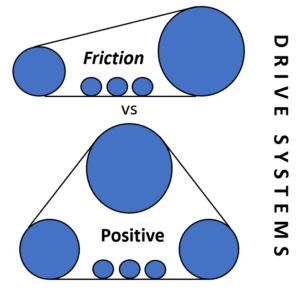
FRICTION DRIVE
Let’s start with the friction-drive track system. These tractors are often well suited to row-crop operations, especially where narrow track widths are needed. They also tend to be lighter and less expensive than large four-track machines, and their undercarriages are comparatively simple. A used friction-drive tractor can therefore be a practical entry point for an operation that wants the benefits of tracks without the cost of a new high-horsepower machine. Common applications include corn and soybean production, grain-cart work, and moderate tillage.
In a friction-drive system, a tensioned belt is pulled by contact with a rubber- or polyurethane-covered drive wheel. Maintaining the specified track tension is essential because mud, moisture, or inadequate tension can allow the belt to slip. Buyers should inspect the belts, guide lugs, mid-rollers, idlers, drive-wheel covering, alignment, and signs of heat or uneven wear. Cracked or deteriorated drive wheels can’t be rebuilt, and replacement parts for older models may be limited or costly. When buying at auction or from a dealer, a thorough undercarriage inspection and a model-specific parts-availability check can prevent an inexpensive tractor from becoming an expensive repair.
POSITIVE DRIVE
Now let’s look at positive-drive systems, in which drive lugs on the inside of the belt engage with a sprocket to transfer power. Four-track tractors generally use either articulated steering, where the tractor turns at a center joint, or front-wheel steering, which feels more like a conventional tractor and may be preferable for frequent road travel and row-crop work. Both designs provide a large footprint and strong drawbar performance for heavy tillage, air seeding, and large planters. Positive engagement can also help maintain propulsion when conditions are wet or when draft loads are high, although drive-lug condition, track alignment, debris ingestion, and undercarriage maintenance remain important. For producers shopping for a new high-horsepower track tractor, many available choices fall into one of these four-track configurations.
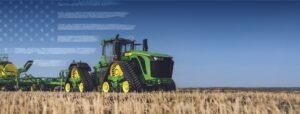
OTHER FACTORS
Drive type is only one part of the decision. Horsepower requirements, implement draft load, soil moisture, transport distance, turning behavior, ballast, dealer support, replacement-track availability, and total undercarriage cost should also be considered. Track width affects flotation, but machine weight, load distribution, inflation alternatives, soil type, and the number of passes all influence compaction. Comparing ground pressure, slip, turning performance, and operating cost under the conditions found on your own farm will give a more useful answer than choosing by track width alone.
The first question to answer is, “Do I need maximum flotation, row-crop compatibility, or a balance of both?” If row-crop compatibility is the priority, a two-track friction-drive tractor may offer narrower belt options, commonly including 16-, 18-, and 24-inch widths, depending on the model. Some machines also allow mid-roller configurations to be matched to different belt widths, while many large four-track systems require rollers sized for the selected track. A narrower track concentrates the machine’s load over a smaller footprint, which can increase ground pressure. In wetter or softer soils, a wider belt and a larger total footprint generally improve flotation, but total machine weight, ballast, load distribution, and field conditions must also be considered.
BOTTOM LINE
Overall, the best system is the one that matches the work, soil conditions, transport needs, and budget of the operation. A used friction-drive tractor can be a cost-effective choice for row-crop work, grain-cart duty, and moderate tillage, provided the undercarriage is carefully inspected and replacement parts remain available. For larger-acre operations pulling high-draft implements, an articulated or front-steer four-track tractor may provide the flotation, traction, and pulling capacity needed to cover acres efficiently. Before buying, compare more than the purchase price: evaluate undercarriage condition, expected maintenance, belt availability, dealer support, and how the tractor will perform in the fields where it will spend most of its time. There is no universal winner, but there is a better fit for each operation.
Michelin
David Graden: Operational Market Manager – Agriculture
Once a producer has made the decision that tracks are the best fit for their operation and soil conditions, the next question becomes: What type of tracked machine is right for me? Do I want a dual-track friction drive tractor, a four-track articulated positive drive machine or a four-track front-steer positive drive machine? Then, just as important, what track width should I choose?
As it relates to which track configuration is better or worse, I really don’t have an answer for this. I don’t believe there is one. It all boils down to the application, soil conditions, farming practices and what the producer needs the machine to accomplish. This is also why Michelin continues to invest in both friction drive and positive drive track technology. Both have a place in agriculture, and both can be very effective when matched to the right application. As we have discussed previously on AG Track Talk, friction drive and positive drive primarily differ in how power is transferred from the machine into the track.
A dual-track friction drive tractor provides a large, long footprint and can be a very good fit for heavy tillage, planting and other applications where straight-line traction, flotation and putting horsepower to the ground are priorities.
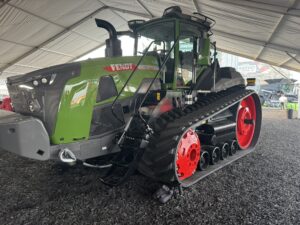
Dual Track Friction Drive
On the other hand, a four-track machine gives the producer four individual ground contact areas and generally offers a different steering characteristic and maneuverability than a traditional two-track machine. Within four-track machines, producers also have choices between articulated and front-steer designs. Again, rather than saying one is better, I would encourage the producer to look closely at field size and shape, number of headland turns, road travel, slopes, soil types, implements being pulled and how much of the machine’s annual use is spent doing each job.
We see this machine choice playing out across the industry. John Deere, for example, has offered both its two-track 8RT platform and four-track 8RX platform, providing different solutions for different producer needs. Other manufacturers have made their own decisions around friction or positive drive systems based on machine architecture and intended applications. That is one of the reasons Michelin has continued developing tracks for both drive technologies.
Track width is where the conversation gets even more specific.
Generally speaking, the wider the track, the larger the potential footprint and the greater the opportunity for flotation and load distribution. That can be especially important in soft soils, wet conditions or applications where minimizing ground pressure and compaction is a major consideration. Tracks are designed to distribute machine weight across the soil while providing traction in demanding field conditions.
However, wider is not automatically better.
If I’m working in row crops, for example, I may need a narrower track to stay within the crop rows. If I’m doing broad-acre tillage with a high-horsepower tractor, row spacing may not be a concern, and I may want to maximize footprint and flotation. Producers farming hills and significant side slopes also need to consider lateral stability and guide-lug loading. The former Camso AG 6500 friction-drive range, for example, offered multiple widths and incorporated guide-lug and carcass designs specifically intended to handle demanding agricultural applications and side loads.
So, when a producer asks me, “What track width do I need?”, I would start with the machine’s weight and horsepower, the implements being used, soil conditions, row spacing and the jobs the tractor will perform most often. I would also look at the worst-case application, not just the easiest one. If that tractor is going to spend part of the year pulling a heavy tillage tool through wet spring soils, we need to account for that when specifying the track.
Another question we hear is: Can I change track widths later if my operation changes?
In many cases, yes, but I would not assume that changing widths is simply a matter of removing one track and installing another. Available widths are dependent upon the tractor, undercarriage configuration and OEM-approved fitments. The AG 6500 friction-drive family, for example, was produced in numerous widths and configurations, but not every width fits every machine. Depending on the machine, changing widths can involve undercarriage components, spacers or other hardware, and you also need to consider machine clearance and row spacing. My recommendation would be to talk with your equipment dealer or Michelin representative before making the change and verify exactly what is approved for your machine.
There is also a new name producers will begin seeing when having these conversations. Camso agricultural tracks have officially transitioned to the MICHELIN BIBTRACK name, which Michelin unveiled at the 2026 Farm Progress Show. Beginning in September 2026, agricultural tracks previously sold under the Camso brand began transitioning to MICHELIN BIBTRACK. Importantly, this is a branding transition and does not, at this time, change the product design, performance or manufacturing process. Michelin’s CTS and TTS agricultural track systems are also moving under the Michelin brand while retaining their existing CTS and TTS product names.
For producers who have relied on Camso tracks for years, I think that’s an important distinction. The name on the side is changing, but the track technology, manufacturing and performance producers have come to know remain the same. MICHELIN BIBTRACK simply brings that track portfolio together with Michelin’s established agricultural.
At the end of the day, selecting the best track setup shouldn’t start with asking which machine or which track is “best.” Start with what you need the machine to do. Understand your soils, applications, loads, row spacing and how the tractor will be used throughout the year. From there, work backward to determine the machine configuration, drive system and track width that best fits those needs. When we get all three of those pieces right, that’s when a producer can really take advantage of what tracks have to offer in terms of traction, flotation, productivity and protecting the soil.