Superior Tire & Rubber
Jerrod Ossa, Aftermarket Sales Manager – AgriTraxx® Undercarriage Wheels
Soil maintenance is a critical aspect for any producer who wants to achieve high, successful yields each year. Maintaining proper nutrient levels in the soil, along with keeping the soil loose, are key factors in achieving strong crop performance. However, over the years, farm equipment has become larger and heavier, which can increase the risk of soil compaction.
Whether an operation uses pneumatic tires or rubber tracks, both systems can cause soil compaction. It is important to understand how soil compaction and flotation differ between these two types of machines.
Soil Compaction Defined
First, let’s define soil compaction. Soil compaction occurs when soil particles are pressed together, reducing the pore space between them. These pore spaces normally hold air and water, both of which are essential for healthy plant growth. When soil becomes compacted, these pores collapse. Some negative effects of soil compaction include shallow root systems, decreased oxygen availability for plants, and increased water runoff rather than water infiltration. Compaction is largely influenced by axle load and ground pressure (PSI).
Pneumatic Tires
Starting with pneumatic tires, rubber tires have a smaller contact area with the soil. If tire pressure is not properly managed, they can exert higher ground pressure (PSI) directly beneath the tire. This can be considered a disadvantage of using rubber tires. The need to adjust tire pressure depending on whether the machine is operating in the field or on the road is critical. The PSI required for road travel is typically much higher than what should be used in the field.
One advantage of tires over tracks, however, is the depth of compaction. Tires generally cause shallower compaction, often limited to the top 6 to 10 inches of the soil profile.
Rubber Tracks
Rubber tracks have a wider footprint, creating a larger contact area with the soil. This wider footprint often results in reduced rutting and less surface disturbance in the topsoil layer. However, the absence of visible ruts does not mean soil compaction has not occurred.
The difference in rutting is related to how each system moves the machine. Tracks tend to grip and pull the machine forward, while tires push the machine forward. Track tractors are often heavier than their wheeled counterparts, which increases the risk of deeper subsoil compaction, typically in the 12- to 24-inch range. This type of compaction is harder to detect and more difficult to correct.
Flotation Considerations
Flotation is another important factor to consider when choosing between tires and tracks. Tracks are generally better suited for operating in wetter soil conditions due to their wider footprint. As a result, less surface damage is usually observed when operating a tracked machine in wet conditions compared to a wheeled machine.
Conclusion
Whether an operation chooses pneumatic tires or rubber tracks, it is important to carefully evaluate the pros and cons of each system before making a purchase. Geographic location, soil type, and budget should all be considered when deciding which option best fits an operation’s needs.
If you are still deciding between tires and tracks, I hope this article has provided helpful information to guide your decision. Be sure to check back with AgTrackTalk next quarter for more tire and track insights to help keep you up to date on all things agriculture-related.
Trackman
Tom Feldmann, Chief Manager of Engineering Development
Each year, as planting and harvest seasons approach, producers often find themselves balancing timing with field conditions. Weather and soil moisture can delay field access, yet the pressure remains to plant on time in the spring and harvest efficiently in the fall.
During these critical windows, getting equipment into the field is essential, but doing so without causing long-term damage to soil structure is equally important. Understanding the relationship between flotation and compaction helps producers make equipment choices that protect soil health and maintain crop productivity.
What is Soil Compaction?
Soil compaction occurs when external pressure compresses the soil, reducing pore space and increasing soil density. As soil particles are forced closer together, the amount of air and water that can move through the soil decreases.
Healthy soils rely on pore space for:
- Water infiltration and drainage
- Root development
- Nutrient movement
- Microbial activity
When compaction occurs, these processes are restricted. Compacted layers can limit root growth and reduce crop yield potential over time. Compaction can also occur deeper in the soil profile, impacting not only the topsoil, but also the upper and lower subsoil layers, where recovery can take years. This recovery requires additional time in the field and additional equipment to break up the top soil and subsoil hard pan, increasing operating costs and equipment needed on the farm.
What is Flotation?
Flotation refers to the ability of agricultural equipment to spread its weight over a larger surface area, allowing machines to travel across soft or wet fields with minimal soil disturbance.
Good flotation helps:
- Reduce rutting in wet conditions
- Prevent soil displacement and structural damage
- Maintain a smoother field surface for future passes
- Maintain a level seed bed
Ruts created during planting or harvest can collect water throughout the growing season and may require additional tillage to repair which is something producers increasingly want to avoid.
The Relationship Between Flotation and Compaction
Flotation and compaction are closely related because both are influenced by ground pressure, typically measured in pounds per square inch (PSI).
Ground pressure is determined by:
Vehicle Weight ÷ Ground Contact Area (Footprint)
Increasing the footprint area lowers PSI, helping equipment “float” on the soil rather than push down into it. Lower ground pressure generally results in reduced soil compaction.
Factors That Influence Ground Pressure
Several equipment factors influence flotation and compaction levels:
- Footprint Area
The larger the contact area between the machine and the soil, the lower the ground pressure. - Axle Weight
Heavier loads, particularly during harvest with grain carts or combines, can significantly increase ground pressure. - Tire Air Pressure
Lower tire inflation can increase footprint, though it must remain within safe operating limits. - Track Undercarriage Design
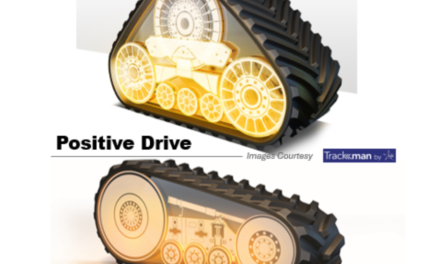
Track systems typically distribute weight across a larger footprint than tires. Modern track undercarriages are engineered with suspension and mid-roller compliance that allow the track to conform to the terrain, helping maintain consistent ground contact and evenly distribute machine weight.
Why Track Systems Improve Flotation
Compared to tires, track systems generally provide greater ground contact area, helping distribute weight more evenly across the soil surface. This increased footprint lowers PSI and improves flotation, especially important when operating heavy equipment in challenging field conditions.
Track technology continues to evolve as equipment size and payload capacity increase. One example is the Brent Avalanche 3298 Grain Cart, currently the industry’s largest capacity grain cart at 3,150 bushels, equipped exclusively with Trackman® tracks.
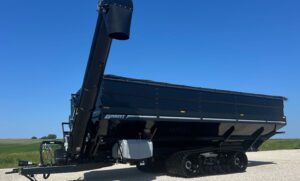
To support the weight and capacity of this machine while minimizing soil impact, Trackman developed the widest grain cart track in the industry, a 50-inch track. Increasing track width expands the machine’s footprint, allowing the system to distribute the weight of both the cart and the grain across a larger area of soil. Combined with an undercarriage designed to maintain consistent ground contact, this helps maximize flotation, reduce rutting, and maintain stability under heavy harvest loads.
Why Producers Should Care
Understanding flotation and compaction is important because soil damage can extend far beyond a single season. Poor equipment choices can lead to:
- Reduced crop yields
- Restricted root development
- Increased water runoff
- Additional tillage costs to repair soil structure
- Additional equipment repairs due to heavy pull conditions
By selecting equipment designed to reduce ground pressure, through tire configuration, inflation management, or advanced track systems, producers can help protect soil health while maintaining operational efficiency.
Rubber Track Solutions
Jerry Von Gruenigen: V.P. Sales & Marketing
When producers evaluate AG tires vs. AG rubber tracks, the conversation often centers around two key performance factors: flotation and soil compaction. While these terms are related, they are not interchangeable. Understanding how each affects field performance, soil health, and ROI is essential when making equipment decisions.
At Rubber Track Solutions, we help producers match their equipment setup to the specific challenges they face in the field because the right solution depends on what problem you’re solving.
What Is Flotation?
Flotation is a machine’s ability to move into and through soft field conditions without excessive sinking.
In practical terms, flotation impacts:
How Flotation Works
Flotation improves when machine weight is distributed over a larger footprint. A larger contact area lowers ground pressure, allowing equipment to “float” across the soil surface instead of digging in.
AG rubber tracks naturally provide:
- A significantly larger contact patch
- More even weight distribution
- Reduced surface pressure
- Improved mobility in soft conditions
What Is Soil Compaction?
Soil compaction refers to the impact equipment weight has on the soil profile as it travels across the field. Excessive compaction (especially 8 inches deep or more in the root zone) can negatively impact crop performance for years. While flotation focuses on surface performance, compaction affects the soil structure below the surface.
Compaction affects:
- Root development
- Water infiltration
- Nutrient absorption
- Oxygen exchange
- Long-term yield potential
Flotation vs. Compaction: Side-by-Side Comparison
| Flotation | Compaction |
| Focuses on machine mobility | Focuses on soil density impact |
| Primarily surface-level concern | Surface and subsurface concern |
| Influences productivity and uptime | Influences long-term soil health |
| Improved with larger footprint | Reduced with lower ground pressure |
| Helps reduce rutting | Helps preserve root zone integrity |
A machine can have good flotation but still create subsurface compaction if weight distribution and axle loads are not properly managed. That’s why producers must evaluate both factors together.
Why AG Track Tractors Are Gaining Popularity
Producers are constantly balancing:
-
-
- Risk management
- Yield protection
- Operational efficiency
- Return on investment
-
AG track tractors offer targeted benefits when flotation and soil protection are high priorities.
Advantages of AG Rubber Tracks
- Larger Footprint
- Better soil protection in the top 8 inches
- Lower ground pressure
- Improved weight distribution
- Increased Traction
- Reduced slip
- More efficient power transfer
- More acres covered per hour
- Enhanced Flotation
- Improved mobility in soft conditions
- Reduced downtime due to weather
- Better consistency across field conditions
Trade-Offs to Consider
No equipment solution is perfect. Producers should also evaluate:
- Reduced roading speed and endurance
- Rougher ride on hard surfaces
- Increased undercarriage maintenance
The right choice depends on soil type, field conditions, cropping system, and how much time the machine spends in-field versus on-road.
Why It Matters
In today’s high-input agricultural environment, protecting every acre matters. When flotation improves and compaction is minimized:
- Yield potential is preserved
- Soil structure remains healthier long term
- Operational efficiency increases
- Weather risk is reduced
- ROI improves
Many producers have determined that the advantages of track tractors outweigh the trade-offs, particularly when soil protection and traction are critical to their operation.
At Rubber Track Solutions, we focus on helping producers evaluate ground pressure, soil conditions, acreage demands, and long-term cost of ownership when selecting agricultural track systems.
Flotation is about mobility. Compaction is about soil impact. Understanding both and how your AG tires or rubber tracks influence each is key to maximizing productivity and protecting your soil for seasons to come.
Ascenso Tires North America
Robert Bender: Product Manager & Tech Support—Off-Highway Tires
Flotation and compaction are often thrown around interchangeably. While they go can hand in hand, they are not the same. They’re related but different, and if the two aren’t separately understood you may miss what is happening in the field.
Flotation, simply put, is the machine’s ability to stay on top of the soil and how it travels through the field. Compaction is what the soil is experiencing underneath that machine and the pressure being pushed down into the soil layers.
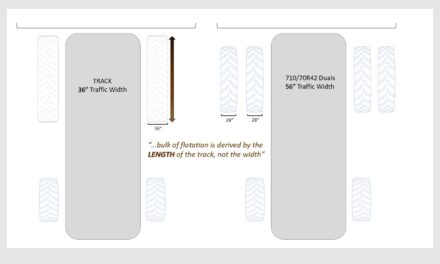
Flotation comes down to footprint, total square inches on the ground. Think of snowshoes. The bigger the contact patch, the better the machine can stay up on top of the soil, especially when conditions get soft. With tires, that footprint is driven by the section width, overall diameter and most importantly inflation pressure, which is often overlooked. You can have all the tire technology in the world, but if pressure isn’t set correctly for the load and speed, you won’t get the footprint you think you have. Lower pressures allow the tire to flex, lengthens the footprint and spreads the load out. Tracks are different in that there is obviously no air pressure to deal with. Footprint is just the length and width of the track. Since a track machine is essentially rolling over its own platform, the track, they inherently float over softer soils better. A tire, however, as it rolls through the field is always creating a small berm or wave of soil in front of the tire which means the machine is constantly trying to climb over that wave, again back to the importance of air pressure, a wider longer footprint will reduce the wave/bulldozing effect improving flotation.
Compaction is related to flotation, but it’s really about weight. Axle weight, machine weight and load per corner and how that weight transfers through the contact patch of either the tracks or the tires into the soil. Because soil type varies so much from field to field or even in different spots in the field it’s very difficult to say what compacts worse but the more moisture that is in the soil or the more frequently traveled the more the compaction can increase. Heavier machines, and/or smaller contact patches are generally going to drive compaction deeper. This is where the conversation takes a turn to the Tracks VS Tire debate. Like I mentioned earlier, tracks inherently provide better flotation, but they don’t always reduce compaction. Tracked machines often weigh 20–30% more than comparable tire machines. Average ground bearing pressure can be low, in that 6-8PSI range depending on track width and length but because of the drive wheels and mid-rollers, that weight isn’t perfectly distributed across the track surface. With that there are load concentration points under the drive wheel and mid-roller that can drive compaction deeper into the soil profile. On the tire side, a properly ballasted tractor running the right tires at the correct inflation pressure for the speed and load can see similar ground bearing pressures, often within 1–2 PSI of actual inflation pressure on a radial ag tire, depending on carcass stiffness and construction. But if that tire is set at road pressure for everything, including field work, the benefit is gone. Air pressure is the cheapest and most powerful adjustment you can make. Another way to mitigate compaction is to create dedicated travel lanes during harvest. While not always feasible keeping heavy grain carts or semis to dedicated paths or unloading combines at the edge of field can also help the deep soil compaction caused by the heaviest equipment in the field.
This is where combining CTIS (Central Tire Inflation System) with VF Technology like our VDR2000 has the largest impact (or lack thereof) on soil and performance. Being able to adjust pressure for load and speed at the push of a button change everything. That allows for relatively quick and easy pressure changes. Without CTIS most machines are doing field work at road pressure. While running a Steel Belted VF tire has several performance advantages if we are talking just about flotation and compaction, an over inflated tire, no matter the construction, will not perform as intended.
At the end of the day, producers need to understand the difference and correlation between flotation and compaction because it directly ties to profitability. Better flotation keeps you moving through the field in sometimes marginal field conditions, improving efficiency (saving time and fuel) while reducing compaction which can help to improve root development, water infiltration and nutrient penetration to the roots (potential yield increases). Combining the efficiency improvements of flotation with benefits of reduced compaction and yield increases affects the bottom line.
It’s equally important for dealers and tire technicians to understand the difference. This allows additional questions to be asked to make the best recommendation for the producer.
What is the axle weight?
What pressure are you running in the field?
Is the tractor ballasted correctly for the job?
Is it time to move up in tire technology?
Does CTIS make sense here?
Flotation is about staying on top and compaction is what is happening underneath. When both are managed correctly, equipment and soil start working together, and that’s when you can start to move the profitability needle.
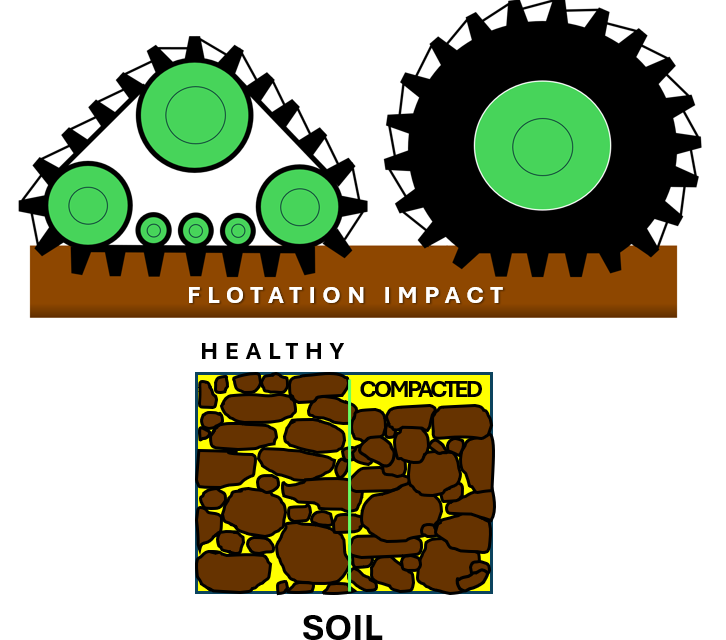
Compaction representation
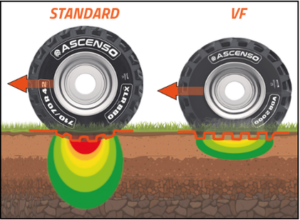
Berm or bulldozing affect from improper air pressure of tires in field. The fuel data doesn’t need to be included.
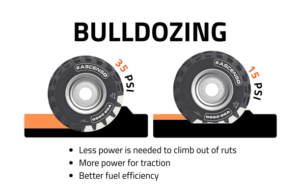
Flotation example with correct air pressure:
BKT USA, Inc.
Dave Paulk: Manager Field Technical Services
Flotation Tire Objective
When assessing a tire’s flotation or setup, the user should aim for it to stay as close to the soil surface as possible. Flotation tires are designed to maximize contact area with the ground and run at lower air pressures, helping distribute the equipment’s weight over a larger area and minimize ground pressure, resulting in reduced soil compaction. On the contrary, it is important to be aware that the lack of flotation can cause ruts, sinking (compaction), and getting stuck (worse compaction) in the field.
Axle Weight Impact
Another key element to consider is the axle weight of the equipment, which needs to be managed to maximize flotation and minimize ground bearing pressure. The tractor needs a certain amount of weight to transfer horsepower to the ground, but too much axle weight can reduce flotation, cause deeper ruts, and increase subsoil compaction.
Air Pressure Impact
Air pressure is fundamental for the load the tractor/equipment is carrying; using less air pressure allows the tire’s footprint to enlarge, which helps distribute weight over a broader area. Here, it is important to consider that for every psi added to the tire, one pound per square inch of ground bearing pressure is applied to the topsoil and then transferred to the subsoil.
Soil Compaction Cause
Compaction is caused by the lack of flotation. Soil should be soft and porous to allow crop root growth to flourish. Porous soil allows air and moisture into the ground and improves fertilizer absorption. In wet weather, the soil will help drain excess water, while in dry weather conditions, it holds moisture better and makes crops more drought-resistant. According to studies, surface compaction is approximately the top 12” of the soil, and this can be managed and generally doesn’t last very long. While subsoil compaction exists below 12” in the soil (in some studies, 6”-18” is used), and this is caused by the total axle weight of the equipment, thus limiting root growth and reducing yields.
Reducing Soil Compaction Solution
IF and VF tires are designed to carry the same load as a standard tire at lower air pressure. Lower air pressure means lower ground-bearing pressure and less soil compaction. A larger footprint will distribute the weight of the equipment over a larger area to reduce pressure on the soil.
It’s important to ensure that tires are inflated to the correct pressure for the load. Overinflated tires can increase soil compaction, while underinflated tires may lead to poor traction and tire failures. Maintaining proper air pressures is crucial to keep the contact patch with the ground consistent.
Soil compaction can be minimized by reducing the amount of traffic on the soil, especially when it is wet. According to studies, about 80% of compaction is caused by the first pass. Fewer trips and controlled traffic patterns can greatly reduce compaction.
Choosing the right tires for the tractor’s and equipment’s weight can help minimize compaction and increase flotation. VF technology, such as BKT’s tires from the AGRIMAX V-FLECTO range for tractors and BKT AGRIMAX PROHARVEST for combines, will enable less air pressure during heavy loads, offering significant benefits in reducing soil compaction and boosting crop and farm productivity.
Yokohama TWS
Norberto Herbener: Senior Technical Account Manager North and Central America
Soil Compaction Defined
Soil compaction is one of the challenging issues a farmer must deal with to obtain a successful crop. Different as with the weather – where the farmer has no control of it – the farmer plays a fundamental role in soil compaction management. Depending upon the farming practices, a farmer can reduce or increase the soil compaction on his land.
In short, soil components are basically solid material of different sizes (sand, silk, clay), organic matter (the living part), water and air. Soil type is defined by the amount of clay, sand and silk each soil type has and gives the soil the specific structure to support vegetal growth. Water is required by the plants to extract nutrients from the soil and air is needed for the living organism and plant roots to flourish. The more air a soil has, the more matter it can store and the looser that soil is for the roots to develop searching for nutrients. The higher the compaction the lower the amount of air is in the soil – here is where the farmer practices can influence the outcome.
Tactics to Reduce Soil Compaction
How can a farmer reduce soil compaction? Every time he passes over a field he is compacting it in different degree of severity depending how heavy the equipment is and the specific task that is being performed. There are several practices one can follow to reduce soil compaction:
1 – Reduce Unnecessary Equipment Passes: every pass compacts the soil and reduces the air content.
2 – Reduce Traffic when Soil has High Moisture Content: soil structure is more easily disrupted with higher water content as water does not compress like air.
3 – Adopting No-Till Practices: no-till reduces the disturbance in the soil and reduces the passes on the field.
4 – Use Subsoiler or Deep Tillage Equipment: deep tillage reduces the hard pan in the subsoil and allows for deeper root exploration and water drainage.
5 – Reducing the Weight per Machine Axle: lighter equipment reduces the compaction as the level of compaction is directly correlated with the weight or load per axle. The machinery trend is going in the opposite way, larger and heavier equipment to reduce time and increase efficiency.
6 – Increasing the Footprint Area in Contact with the Soil: here is where the farmer has more influence in reducing his soil compaction. Let’s dive deeper in this concept. If we consider a specific equipment, the weight of it and the load on each axle will not change, what the farmer can do is to change the area that load is applied on and will change the “pressure” this equipment will do on each square inch of the soil.
Flotation Defined
This increase in contact area, or footprint area, would allow to reduce the impact of the equipment load on the soil to reduce compaction and its normally called flotation. Saying this – higher flotation=lower compaction. There are to ways to increase the footprint area and flotation (assuming equipment weight stays the same), a wider footprint and a longer footprint.
How to Increase Inflation
We can achieve a wider footprint basically by using wider tires or tracks. In the case of tires its fundamental to adjust to the correct air pressure of the load the tire must carry and allow the tire to “squat” to the sides. Tires are designed to squat, so don’t be afraid for them to do so.
A longer footprint is achieved by using a longer track system or on the tire side a taller tire, and in the same case as before, adjust to the correct air pressure for the load enabling the tire to “squat” front to rear.
Tire construction also influences the shape of this footprint area, a bias (X ply) type tire will provide a more oval footprint area, a radial type of tire construction provides a squarer footprint area, larger than a similar size tire bias construction.
Balancing Flotation & Traction
If more flotation – that a larger footprint area could provide – appears to be the solution to reduce the compaction as much as possible, then why do equipment manufacturer and farmers not use/offer very large tires that could provide extreme flotation? Apart from being expensive and difficult to transport between fields, the equipment tires or tracks need some level of traction to transmit the engine generated power and torque and perform the task.
Assuming for an example a tractor pulling a planter behind, the lugs of the tires or tracks must sink into the soil surface to have some grip and be able to pull. This soil penetration is directly related with the load each tire or track must carry per square inch, the higher the load per square inch, the deeper the lug sink in the soil providing more grip. As we can see here there is a balance between flotation and traction. The more extreme the flotation, the lower the traction, and vice versa.
In Sum
Once the tractor is correctly ballasted, find the tire that can provide a balance between the largest footprint area possible with the desired traction performance.
Maxam Tire International
Trevor Wilson: Marketing Specialist
Farmers and growers are challenged by the inherent working conditions found in their fields which can range from very dry to very wet. Over the last decades, the Ag industry has continued to shift towards larger equipment with higher horsepower seeking greater productivity and improved yields. This technological shift has accelerated the use of tracks as well as the proposed traction and flotation solution in farming operations that have either very deep or very wet soil conditions. The expected or perceived benefits of track usage include improved productivity, reduced field rutting, and lower soil compaction. The table as well as comments below are a comparison of tires versus tracks to summarize the benefits and issues associated with the use of wheeled or track solutions impacting the ground pressure applied to their soil conditions influencing the ability maximize crop yields.
Ground Pressure Effect of Tires vs. Tracks on Soil:
Understanding the impact of ground pressure from tires or from tracks is the key to managing the best solution for your farming operation:
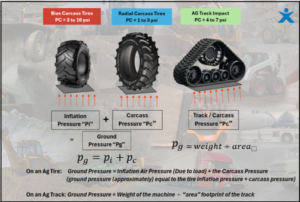
Adjusting the tire’s air pressure to match its axle load (weight) based on the required working speed increases the tire footprint maximizing its contact patch to gain flotation. Similarly large tracks due to the width and length of the track spread the axle loads over a larger contact area, which should lower ground pressure and reduce soil compaction. Over time, it has been found that Bias Ply tires are the least effective option for ground pressure because they require higher air pressures to carry a given load and are built with more layers resulting in heavier carcasses. Radial tires with a single casing wire deliver a lighter carcass that with newer technology VF construction improve results further using exceptionally low air pressure to create a larger footprint. Tracks on the other hand due to the width and length of their contact patch offer increased flotation as well as traction, especially in soft soil or very wet conditions allowing them to operate efficiently where tires using higher inflation air pressures will be more limited.
When it comes to compaction, bias and radial tires vary, the difference lies largely in the casing design. To reduce compaction, the sidewall of the tire needs to deflect/flex outward to increase the width and length of the footprint. The greater a tire sidewall can deflect the longer the tire footprint will grow. The easier a tire sidewall can flex (deflect) the resulting increased contact patch or footprint reduces ground pressure and lowers soil compaction. Since a bias tire has a thicker carcass, it requires much more force and weight pushing down to flex the sidewall compared to a radial. The latest VF radials with more flexible casing construction and lower air pressures for a given axle load provide an even higher degree of sidewall deflection to get the largest footprint versus standard radials or bias tires.
The general perception in the market is that radial tires operating below 20 PSI cold inflation air pressure can deliver lower ground pressure that can rival what tracks offer with their large track footprint. What does not change are the impacts to both surface and sub-surface soil compaction, whether using bias tires, radial tires, or tracks. The market perceived benefit of using tracks over wheeled equipment is in deep or wet soils where tracks help to eliminate the rutting caused by tires requiring applied torque to push through the soft conditions. However, the perceived advantage of tracks in reducing ruts or lowering soil compaction comes at a cost, as tracked machinery is more expensive to operate than wheeled machinery.
Tracks offer better traction due to reduced slippage, but they require more horsepower and heavier components, leading to significantly higher fuel consumption than wheeled systems. Despite a large footprint, the weight is not equally dispersed across the tread face. The area directly under the mid rollers, and idler wheels will have a greater load than the other areas of the tread. Wheeled machinery also can also operate at faster road speeds (over 25-mph) compared to the 20-mph limit for tracked equipment. Most importantly tracked machinery cost 30% to 40% more to operate because they have more moving parts and require increased maintenance. While tracks can provide improved flotation and traction in wet or deep soils when compared to wheeled machinery, tires using adjustable tire pressure systems or Central Tire Inflation (CTIS) can allow farmers to lower their air pressure below 20 psi to overcome wet or soft soil conditions. Ultimately, each farmer or grower must weigh these factors to choose whether wheeled solutions (bias or radial) or tracks are the best fit for their operation.
MAXAM is constantly developing new VF and standard tires sizes to not only complement our existing offer, but also to meet the evolving global demand for higher load, platform, or technological market changes. Soon MAXAM will be bringing Ag tracks to supplement our newly released construction track offer ensuring our innovative designs will exceed market expectations for load, speed, traction, and endurance.
Our MAXAM Ag brand approach strategy as our product developments continue to evolve is to deliver standard tires, VF tires, and track solutions to the agricultural marketplace.
All information is provided in this blog solely to provoke thought. All deductions made from information on this site must be confirmed by Certified Ag Tire / Track Dealer & Tire / Track Manufacturer before use. Ag Tire/Track Talk does not recommend anyone conduct tire service work with exception of Certified Ag Tire/Track Dealer Professionals.